

Fear as Propulsion
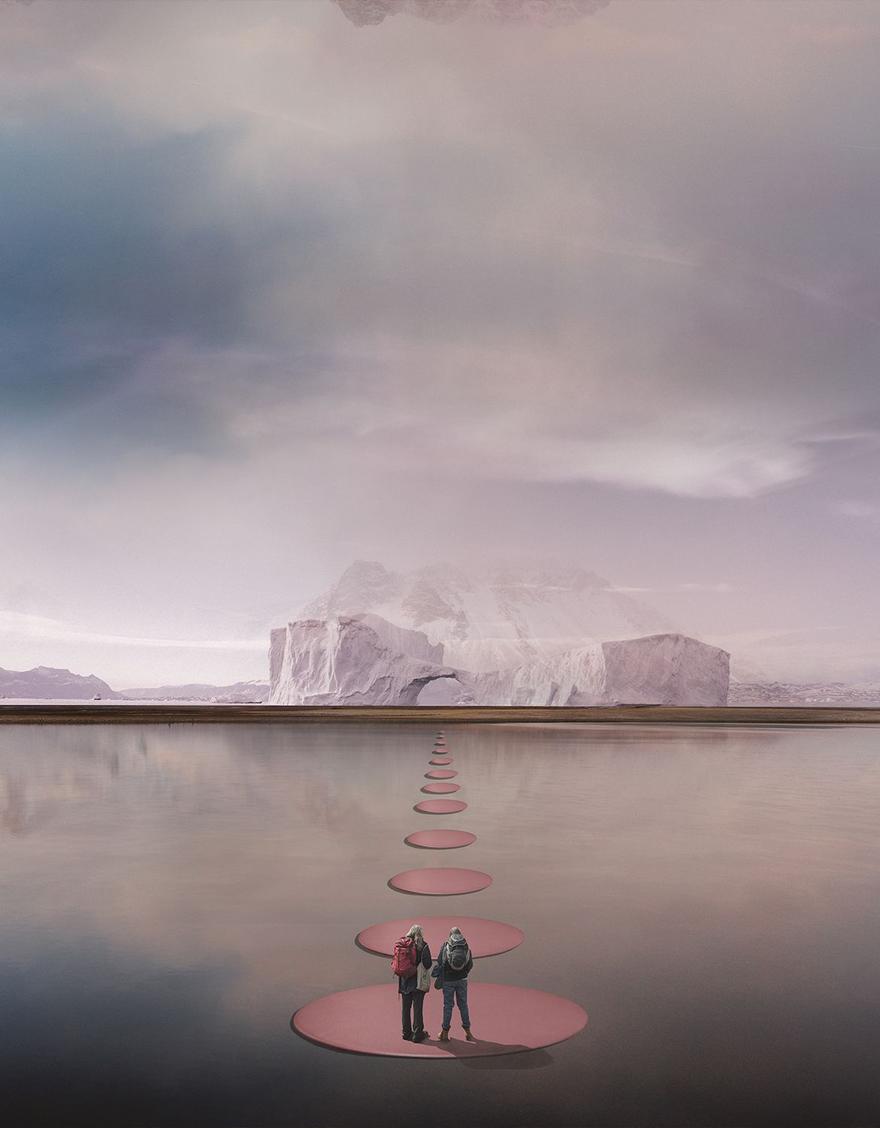
I want to invite you into something before we go anywhere.
Not an idea.
Not a theory.
Not another piece of information to collect and place neatly inside your head.
For a moment, notice your fear.
Not why you're afraid.
Not what happened to make you afraid.
Not whether the fear is rational.
Not what you're going to do about it.
See if you can resist the almost immediate desire to explain it.
Instead, notice your body.
Your hands.
Your feet.
Your chest.
Your stomach.
Your breathing.
Your heartbeat.
Your jaw.
Your throat.
Notice temperature. Pressure. Tingling. Constriction. Heaviness. Lightness. Movement.
And then notice whatever emotions seem to be sitting alongside the sensations.
Fear.
Apprehension.
Overwhelm.
Confusion.
Maybe grief.
Maybe anger.
Maybe nothing you can name.
Stay there for a moment.
Because something interesting happens when we allow ourselves to feel without immediately reaching for an explanation.
Most of us are extraordinarily skilled at explaining ourselves.
We can tell you why we're angry.
Why we're anxious.
Why we're overwhelmed.
Why we're behaving the way we're behaving.
Why the other person is wrong.
Why we're right.
Why our childhood made us this way.
Why our boss is the problem.
Why our relationship is the problem.
Why our body is the problem.
Why the world is the problem.
And sometimes those explanations are accurate.
But I've wondered for a long time whether explanation can also become one of the most sophisticated ways we avoid experience.
We feel something uncomfortable, and within milliseconds the mind begins building a story around it.
The story gives the sensation context.
Then meaning.
Then identity.
And sometimes the story that supposedly explains the feeling actually helps keep the feeling alive.
What if, occasionally, we didn't do that?
What if for sixty seconds you simply felt what was there?
No fixing.
No healing.
No transcending.
No raising your vibration.
No turning it into something prettier.
What might you discover?
Fear is an interesting creature.
We tend to have a very particular relationship with fear.
Fear is something to overcome.
Conquer.
Release.
Heal.
Move beyond.
Fear is standing between me and the life I'm supposed to have, so if I can finally become brave enough, evolved enough, healed enough or conscious enough, I won't be afraid anymore.
I'm not convinced.
In my own life, fear has been one of the most powerful creative forces I've ever encountered.
It has also been one of the most constricting.
That paradox interests me.
Because fear can make a human being astonishingly creative.
Give someone an emotional need they don't know how to meet directly, and watch how inventive they become.
We learn how to achieve.
How to disappear.
How to become funny.
How to become powerful.
How to become agreeable.
How to become attractive.
How to become indispensable.
How to become intelligent.
How to become successful.
How to become invisible.
How to become whatever version of ourselves seems most likely to keep us safe, connected, valued and wanted.
That is creativity.
Maybe not the kind we hang in a museum.
But creativity nonetheless.
And somewhere along the way, many of us become so good at creating ourselves that we forget we're doing it.
I wonder when that begins.
There is a distinction I've been playing with between innocence and avoidance.
Innocence, to me, contains curiosity.
Imagination.
Openness.
Mystery.
A willingness not to know.
A certain humility toward life.
And then life happens.
We experience pain.
Shame.
Rejection.
Separation.
Confusion.
Moments we don't yet have the capacity, language or support to understand.
And somewhere along the way, perhaps we begin to move from innocence toward avoidance.
Not because something has gone wrong with us.
Because avoidance works.
At least for a while.
Children spend enormous amounts of time in innocence.
They imagine.
They invent.
They ask ridiculous and beautiful questions.
They move fluidly between what is known and what might be possible.
Until pieces of that openness begin meeting the outside world.
A teacher laughs.
A parent dismisses.
A coach shames.
A sibling mocks.
A group excludes.
We learn that certain parts of us are celebrated and other parts seem to cost us connection.
Something cracks.
Maybe only a little.
And we learn.
Don't show that.
Don't say that.
Don't ask that.
Don't feel that.
Be this instead.
And then something extraordinary happens.
We get creative.
We begin constructing ways of avoiding the experiences we don't know how to hold.
Maybe I achieve so I don't have to feel inadequate.
Maybe I become indispensable so I don't have to feel disposable.
Maybe I disappear so I don't have to experience rejection.
Maybe I control so I don't have to experience uncertainty.
Maybe I accumulate knowledge so I don't have to sit inside the vulnerability of not knowing.
Maybe I become who everyone needs me to be so I don't have to risk discovering whether they'll stay if I'm simply myself.
And eventually these strategies become so familiar that we stop experiencing them as avoidance.
We experience them as us.
My personality.
My work ethic.
My standards.
My ambition.
My independence.
My identity.
And perhaps some of those things genuinely are expressions of who we are.
I'm not interested in reducing every beautiful thing about a human being to trauma wearing a clever disguise.
I'm interested in something subtler.
How much of what I call myself was created to keep me from experiencing something I once didn't know how to feel?
Because the adaptations aren't stupid.
Some of them may have been brilliant solutions.
The question is whether we're still using them long after we've forgotten what they were designed to protect us from.
Fear can build empires.
I've worked with people inside organizations known around the world for creativity and innovation.
From the outside, we see the products.
The ideas.
The technology.
The disruption.
The brilliance.
What we don't necessarily see is what can exist underneath the machinery.
Who's going to catch us?
Who's going to beat us?
Who will create the next thing before we do?
What happens if we're no longer number one?
That fear can generate extraordinary innovation.
It can generate extraordinary sacrifice too.
Time.
Relationships.
Bodies.
Sleep.
Presence.
Blood, sweat and tears poured into staying at the pinnacle.
Which raises a question I think is far more interesting than whether fear is "good" or "bad."
What are the benefits and consequences of using fear as fuel?
Because there are benefits.
That's the uncomfortable part.
Fear works.
Shame works.
Insecurity works.
They can make you study harder.
Train harder.
Work longer.
Build companies.
Make money.
Get lean.
Earn degrees.
Become impressive.
Create beautiful things.
Fear can propel you toward the horizon with extraordinary force.
But fear can also do the opposite.
When we experience threat, our world can become smaller.
Our attention narrows.
We reach for what is familiar.
We repeat old patterns because familiar can feel safer than unknown.
The person propelled by fear creates more.
The person constricted by fear may create less.
One becomes visible.
The other disappears.
And culturally, we tend to celebrate the first one.
Look how driven she is.
Look how successful he is.
Look how much they've accomplished.
Look how disciplined they are.
We rarely ask:
What is doing the driving?
I was asked that question once without the person realizing what he was asking.
I was on a podcast and the host was introducing me.
He started reading my accomplishments.
And reading.
And reading.
Education.
Courses.
Certifications.
University.
Experiences.
Things I'd built.
Things I'd done.
Eventually he stopped and asked me something along the lines of:
"How did you do all of this? How did you find the time?"
I asked him if he wanted the truth.
He said yes.
So I gave it to him.
Part of me was insecure enough to believe that if I accumulated enough education, enough courses, enough knowledge, enough accomplishments, eventually you would see it.
And if you saw it, maybe it meant I mattered.
He was surprised.
All of this came from insecurity?
In part, yes.
Absolutely.
And again, I'm not interested in making that wrong.
Look at what it created.
I've learned extraordinary things.
I've met extraordinary people.
I've built things I'm proud of.
I've been able to help people because of some of that education.
Fear created something.
But there is another side of the equation.
A part of me felt insecure enough about who I was that I built a tremendous pile of doing in an attempt to finally experience being enough.
And here's the little cosmic joke.
You can build an enormous pile and still not feel like you matter.
Because outside validation works.
For a moment.
Someone recognizes you.
You accomplish the thing.
You make the money.
You get the body.
You earn the title.
You receive the applause.
There it is.
Finally.
Enough.
And then the nervous system quietly asks:
"Okay. What's next?"
The finish line grows legs.
Because if the original wound says, "I don't matter," no amount of external evidence can permanently settle the argument.
There will always be another course.
Another achievement.
Another dollar.
Another body-fat percentage.
Another business.
Another person whose approval we need.
Another mountain behind the mountain.
So perhaps the question isn't:
How do I stop being afraid?
Perhaps the question is:
What is my fear creating?
Sit with that one.
What is your fear creating?
Does fear propel you?
Does it inhibit you?
Do you become louder?
Quieter?
More productive?
More avoidant?
More agreeable?
More dominant?
More attractive?
More educated?
More successful?
More spiritual?
More helpful?
More needed?
What have you become exceptionally good at because some part of you was once afraid not to become it?
That's an uncomfortable question.
I think it's also a beautiful one.
Because we're no longer trying to destroy the adaptation.
We're getting curious about it.
Maybe the part of you that became extraordinarily successful deserves to be understood rather than worshipped.
Maybe the part that hides deserves to be understood rather than shamed.
Maybe the perfectionist isn't the enemy.
Maybe the procrastinator isn't either.
Maybe both are creative expressions of a system attempting to meet a need.
And if that's even partially true, the invitation changes.
Instead of asking:
"How do I get rid of this?"
We might ask:
"Can I get to know this?"
I wonder if we could become friends with our fear.
And with our shame.
Those aren't particularly fashionable words.
We're frequently encouraged to transcend them.
Raise our vibration.
Replace them.
Think positively.
Move into abundance.
I don't experience fear or shame as spiritual defects.
I experience them as information.
They tell me something about what matters.
What hurts.
What I'm protecting.
What I'm trying to prove.
Where I feel unsafe.
Where I'm still performing.
Where I'm hiding.
Where I'm desperately trying to be seen.
And perhaps, if I'm willing to follow them downward instead of trying to climb away from them, they bring me closer to the roots.
Imagine looking at a patch of grass.
Anger might be visible above the soil.
Jealousy.
Grief.
Frustration.
Control.
Defensiveness.
Achievement.
Perfectionism.
But underneath all of that is an enormous root system.
And somewhere deeper in the soil we may find fear.
We may find shame.
We may find the quiet belief:
I'm not enough.
I don't matter.
I'm not safe.
I won't belong.
And suddenly the thing we've been trying so hard to eliminate becomes a doorway.
Not something to celebrate.
Not something to condemn.
Something to know.
Which brings me back to creativity.
I wonder how much of what humans have created has emerged, at least partially, from fear.
Our businesses.
Our technologies.
Our art.
Our physiques.
Our religions.
Our identities.
Our accomplishments.
Our masks.
Maybe fear has always been sitting somewhere in the creative process.
Sometimes whispering.
Sometimes screaming.
Sometimes expanding our imagination.
Sometimes narrowing it until we can see only one path.
Maybe the goal isn't to create a life in which fear no longer gets a seat at the table.
Maybe it's to finally notice that fear has been sitting there all along.
And then, rather than throwing it out, we turn toward it.
We listen.
We become curious.
We notice what happens in our body when it speaks.
And perhaps, with enough awareness, something subtle begins to change.
Fear can still be present without unconsciously holding the steering wheel.
The mask can still exist without us believing it is our face.
Achievement can still be beautiful without needing to prove that we're worthy.
Creation can remain.
Ambition can remain.
Curiosity can remain.
The difference may be that we're beginning to know what part of us is creating and why.
So I'll leave you with the question I've been sitting with myself:
As you move toward whatever you're trying to create, become, achieve or change, where is the drive coming from?
Don't rush to answer it.
Feel first.
Notice your body.
Notice the fear.
Notice the shame.
Notice the part that wants to explain all of it away.
And maybe, for one minute, don't.
Stay curious.
There might be something underneath the grass worth meeting.
Jator 👽

0 comments
Leave a comment
Please log in or register to post a comment